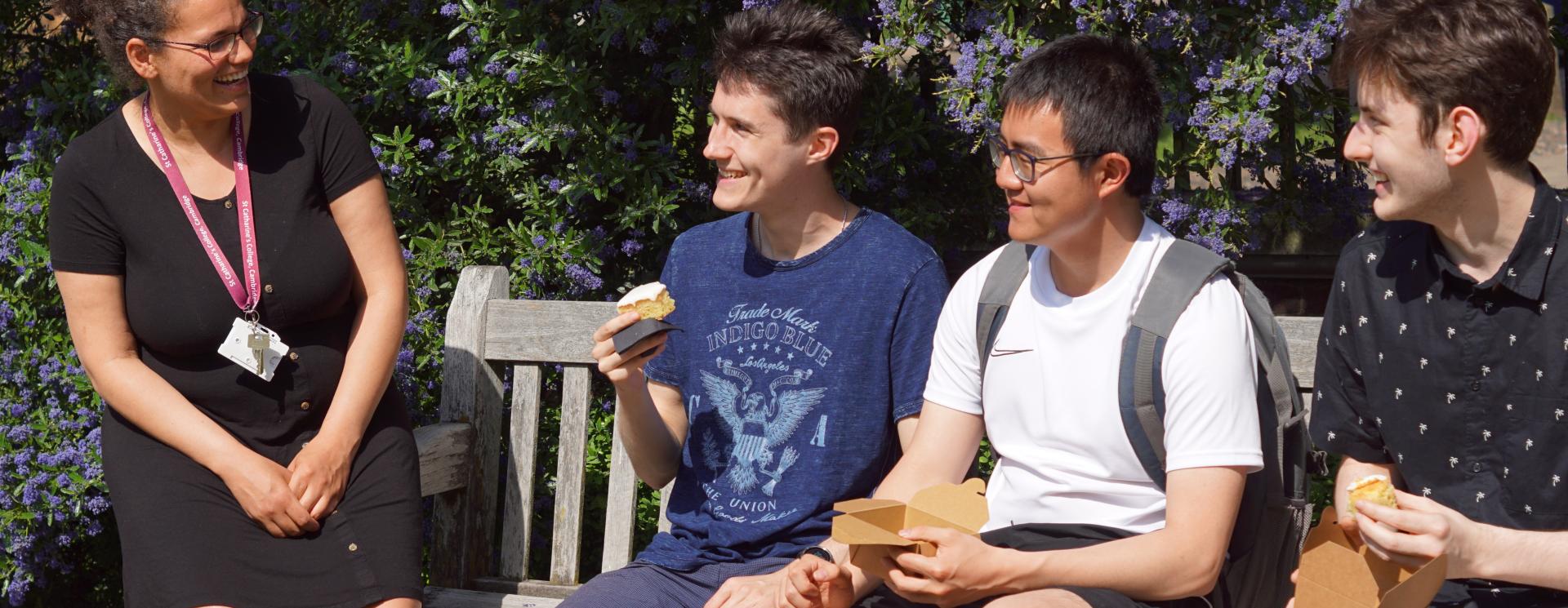
St. Catharine’s is a College with a particularly strong reputation in Natural Sciences. Every year, we are either near or at the top of the Cambridge academic rankings in this subject. We pride ourselves in taking students from all sorts of backgrounds, most of whom have no family experience of Oxbridge. We believe that our achievements in Natural Sciences reflect the individual attention and encouragement that St. Catharine’s Fellows (the lecturers attached to our College) are prepared to give to our science students, who form a particularly coherent, friendly and focussed group.
St. Catharine’s accepts some 25-35 natscis each year, including one or two who will move across to the Chemical Engineering Tripos in their second year: together they form more than 20% of the undergraduate population. The College is a lively and varied place to study Natural Sciences, not least because of the John Ray Society, the College Natural Science society. Named after the famous 17th century naturalist who was a member of St. Catharine’s, and run by the undergraduates, the John Ray Society organises talks by visiting scientists and Fellows as well as social events for the College natscis. We also have an excellent and newly-refurbished library, well-stocked with the latest core texts, which is a pleasant place to work. There are a number of scholarships and prizes available for those natural science undergraduates who perform particularly well in their exams.
The St. Catharine’s Fellowship is particularly strong in the Natural Sciences not just in terms of research, but also in terms of teaching. Many of our Fellows have significant roles in teaching and examining the undergraduate courses for the University, including Dr. Dalley (neuroscience), Dr. Harrison (materials), Dr. Mason (physiology), Dr. Oliver (cell biology) and Dr. Wothers (chemistry). You may have seen Dr. Wothers give the Royal Institution Christmas Lectures in 2012!
The St. Catharine's Fellows share the responsibility of guiding our Natural Science students through their courses, and they conduct many of the supervisions personally. The interest that Natural Science Fellows take in the academic progress of their students in St. Catharine’s represents a key reason for our success in this area. Indeed, the particularly close mentoring between our Fellows and students represents one of the most important things which distinguishes St. Catharine's from other Colleges.
Information on specific subjects
At St. Catharine's, we take students reading all Natural Sciences courses. Please follow the web-links below for further information about some of these subjects.
Physiology at St. Catharine's
Neuroscience at St. Catharine's
Pathology at St. Catharine's
Plant Sciences at St. Catharine's
Entry requirements
Please see the University guidelines for Natural Sciences entry requirements and the St. Catharine's admissions webpage for details of general course requirements and how to apply.
St. Catharine's normal offer for Natural Sciences is A*AA at A2 level (or equivalent) in specified science/maths subjects; we do not require STEP or S level papers. In addition to the University guidelines (follow link above), we strongly recommend that biological candidates are taking A2 level (or equivalent) chemistry and mathematics, as many of the first year courses will prove difficult without this background. We also very much favour three science/maths A2 levels rather than two plus another subject. Candidates with alternative subject combinations may find themselves at a competitive disadvantage during the admissions procedure.
Last modified 4th January 2013